Turmeric (Haldi)

 
Halud flower
Turmeric flower

Names of Turmeric in different languages

Turmeric is commonly called haldi  in Hindi

- Halud in Bengali

- Holodh in Asamese

- Halada in Gujrati

- Haladar or Halaj in Punjabi

- Manjal in Tamil

- Manjella-kua in Malayalam

- Pasupu in Telugu

- Arisina in Kannada

- In Sanskrit it is called Haridra, Barabanini, Kanchani, Krumighni, Joshitapriya etc.

- In English it is known as turmeric

- We call it Haldi in Oriya too.

The Botanical name is Curcuma Longa (Zingiberaceae family)

Medicinal Properties of Haldi (Curcuma Longa)

The plant has anthelmintic, astringent, alkaline, anti oxidant, anti¬arthritic, antifungal, antiprotozoal, insecticide, spasmolytic, hypotensive, antifungal, antibacterial, anti-inflammatory, and  hypoglycemic, properties. 

 
Halada-haldi flower
Haldi flower
 
 
Halud,Holodh,Halada,Manjal,Manjella-kua,Pasupu,Arisina,Haridra,haladi,turmeric leaf
leaf of turmeric


Emperor's candlesticks-Vilayatiagati

Names and uses medicinal property of Christmas candle or Seven golden candlesticks

Emperor's candlesticks or Empress Candle Plantis also known in English as Christmas senna, Popcorn senna, Christmas candle, Seven golden candlesticks, Candlestick senna, Candle bush, Candle cassia, Candelabra bush, Ringworm bush, Ringworm senna, Wild senna, Winged Senna, Golden candelabra, Roman Candle tree, Stick senna, Yellow top weed or simply Candle tree. It is called HinglajDadmurdan, Vilayatiagati and Dadu Ka Pattain Hindi, Dadmari, Dadumardan in Bengali, Seemaiagathi, Anjali, Vandugolli in Tamil, Mettatamara, Simayavisa in Telugu, Aanattakara, Malamtakara, Puzhukkadittakara, Seema agatti in Malayalam and Doddachagache in Kannada. It is called Dadrughna, dwipagasti in Sanskrit. In Oriya we call it Jadumari (Jadu means scabbies and mari means killer).
 
Candelabra bush, Ringworm bush,
Senna alata or Cassia alata
Its Botanical name is Senna alata or Cassia alata.
This plant is native to the Tropics, including Africa, Southeast Asia, the Pacific Islands, and South America. Its natural distribution is exceptionally extensive. It is widely distributed in the tropical countries. In many countries it is often considered as a weed. But it is an important medicinal tree apart from being an ornamental plant.

Dadmari,Vandugolli
 Simayavisa
 

It is a perennial shrub with ornate yellow flowers which blooms through most of the year. The shrub grows up to 3–4 m tall, with leaves 50–80 cm long. The flower looks like a yellow candle. It begins blooming in October and it has a long blooming season, from autumn almost throughout the winter. The fruit shaped like a straight pod is up to 25 cm long. The seed pods are dark brown or nearly black, about 15 cm long and 15 mm wide. Pods contain 50 to 60 flattened, triangular seeds. It is grown as an ornamental plant for its pretty yellow flowers. Cassia alata is easy to grow from seed. It is a fast grower and flowers in the first year. The plant is suspected of being poisonous to livestock.


Aanattakara,Doddachagache
 seeds of Candelabra bush


Cassia alata or Senna alata has anti-helminthic, antibacterial, laxative, diuretic, Antifungal, Analgesic, alterative, Antiseptic, Anti-inflammatory, Antibacterial, Hepatoprotective, abortificent, aperient, purgative, Antimicrobial, diuretic, anti-herpetic, soporific properties .


Its fungicide property derives from chrysophanic acid. It is often called the Ringworm Bush because of this strong and effective fungicidal property, for treating infections such as athlete's foot and chronic fungal infection. Crushed leaves and juice extract is used for treatment of scabies, eczema, insect bites, impetigo, syphilis sores, psoriasis, shingles, rash and itching. Skin problems are most often treated by applying leaf sap or by rubbing crushed fresh leaves on the skin.


It is also used for treatment of uterine disorders. The Plant also cures inflammation, cough, bronchitis, asthma, constipation, hemorrhoids, alopecia and sexual debility. In Ayurveda the plant is used as a cure for poisonous bites. In veterinary medicine too, a variety of skin problems in livestock is treated with leaf decoctions.

N.B. All the above is solely for informational purpose and NOT INTENDED TO PROVIDE ANY KIND OF MEDICAL ADVICE. A REGD. AYURVEDIC/MEDICAL PRACTITIONER SHOULD ALWAYS BE CONSULTED FOR IT.
 
 
Aanattakara,Doddachagache
 Candelabra bush


Ringworm bush, Hinglaj
 Hinglaj

Chhatiana

Names of Chhatiana or Blackboard tree

Chhatiana is called Blackboard tree, Devil tree or Indian devil tree, Ditabark, Palmira Alstonia, Milkwood, White Pine, Milky pine or Milkwood pine, White cheesewood in English. It is called  Shaitan ka jhar, Satvan, Chatiun, Chattiyan, Satni in Hindi, Chhatim or Chatnia in Bengali, Satiana or Sotiana in Asameses,  Satvinin Gujarati and Marathi, pala, Tirunamappalai, Captaparanam, Elilai-p-palai, Mukumpalai in Tamil, Devasurippi, Edakula-pala, Elaramu, Pala-garuda in Telugu, Yakshipala, Daivappala , Elilampala, Kotapala, Mangalappala, Mukkan-pala in Malayalam, Elelehale, Kodale, Mudihale, Pale, Bantale, Haale in Kannada, Kashim in Urdu. In Sanskrit it is called Saptaparna,Vishala tvak, Vishamacchada, Devavirshika, Bahuparna, Gandhiparna, Grahanasha, Guchhapushpa, Jivani, Madagandha, Munichhada, Palagaruda, Shalmalipatraka, Sharadipushpa, and Suparnaka. In Oriya we call it Chhatiana.

Palmira Alstonia, Milkwood
Bud of chhatiana


The botanical name is Alstonia scholaris or Echites scholaris or Pala scholaris. The tree has got its generic name from the renowned 18th century botanist, Prof. C. Alston of Edinburgh University. The specific name scholarisis derived from the traditional use of the wood for slates or school boards in Myanmar.

,Satvan,Chatnia
 Palmira Alstonia flower,


Chhatiana is native to the Indian subcontinent and Southeast Asia. It is evergreen. It is a tall tree that grows up to around 50 to 80 feet height with highglabrous trunk. The bark is grayish. Branches are whorled, and so are the leaves. The slightly rounded at the apex, leathery, dark green leaves form whorls of 3-10. The upper side of the leaves is glossy, while the underside is grayish. White funnel-shaped strongly perfumed flowers bloom in the month October. The flowers are crowded, numerous, somewhat hairy, and are a colour blend of white, cream and green; about 1 centimeter long, hairy in the throat. The seeds are oblong, with ciliated margins, and ends with tufts of hairs 1.5–2 cm. The tree has regular branches and of a very symmetrical shape. The bark and leaves produce a milky latex when injured, which is toxic. All parts of the tree can be considered poisonous.The bark is very bitter in taste. Ditamine is a useful alkaloid obtained from this tree. That’s why it is also called Ditabark. Leaves are generally found in the group of seven. That is why it is called Saptaparni in Sanskrit and some other Indian languages also because Sapta means seven and parnimeans leaves. The fruition period is late winter season i.e. January to February.

It naturally grows in lowland rain forest particularly in cyclone prone areas and is widely found in the countries of India, China, Bangladesh, Sri Lanka, Thailand, Cambodia, Indonesia, Laos, Malaysia, Myanmar, Nepal, Papua New Guinea, Philippines, Solomon Islands, Vietnam and Australia. It is found in almost all parts of India. It grows better under moist, warm climate but cannot stand water logging. The wood is soft and suitable for pulp and paper production. The timber is used for pattern making, packing, slates, boxes, corks, blackboards, coffins, core stock, plywood, carving and mouldings etc.

The tree is highly medicinal and is immensely valuable from Ayurvedic point of view.


Pala-garuda,Mukkan-pala
Chatnia Tree

It is Anticancer, Antimicrobicidal, analgesic, febrifuge, stimulant, Antimalarial, antiamoebic, antidiarrheal, antihypertensive,  hepato-protective, immune-modulatory, anti-asthmatic, anti-oxidant, anti-inflammatory, anti-fertility, anti-diabetic, Anti-pyretic and cardiotonic.
In Ayurveda the bark and milk exudates is used solely for medicinal purposes, ranging from Malaria and epilepsy to skin disorders and Asthma, Foul Wounds, Sinus, Dyspepsia,Urticaria, Bowel Complaints, Cough, Leprosy, Toothache, Rheumatism, and for upper purification process of Panchakarma in Ayurveda. The bark and latex is considered tonic and antiseptic. The bark is used in chronic diarrhoea and advanced stages of dysentery.  It’s a blood purifier. The Milky juice of the tree and the Poultice of young leaves are applied to ulcers. A decoction of the leaves is used for treating beriberi, dropsy and congested liver. The bark is used for making medicine in Homeopathy; In Homeopathy also it is particularly useful for chronic diarrhoea and dysentery. In Ayurveda, infusion of bark soaked overnight is used in treatment of diabetes.The bark serves as an alternative to quinine without its side effects. The bark is also used as an antidote to snake bite.

N.B👉. All the above is solely for informational purpose and NOT INTENDED TO PROVIDE ANY KIND OF MEDICAL ADVICE. A REGD. AYURVEDIC/MEDICAL PRACTITIONER SHOULD ALWAYS BE CONSULTED FOR IT.


Touch-me-not

Sleeping Grass,Lajwanti
Sleeping Grass flower,

Names of  plant  Touch me Not (Mimosa pudica) in different languages

Touch me Not is also called Sensitive Plant, Humble Plant, Prayer Plant and Sleeping Grass.

- It is called Lajwanti, Lajouni and Chui-mui in Hindi

- Lajjabati and Laajak in Bengali

- Nilajban in Assamese

- Kangphal or Ikaithabi in Manipuri

- laajari or laajaalu in Marathi

- Reesamani in Gujrati 

- Tottalavaadi or Thottaccurungiin Tamil

- Tintarmani, Teattavatior Thottavaadi in Malayalam

- Attaapatti in Telugu

- Nachike Mullu, Muttidare Muni in Kannada

- In Sanskrit it is called Lajjalu, Shamipatra,Sankochani, Raktamoola, Raktapaadi, Samangaa, Khadiraka, Namaskaari, Gandhakari, Prarochani  etc.

 -We call it Lajkuli or Lajkuri lata in my mother tongue Oriya.

The Botanical name is Mimosa pudica L. (Mimosaceae family)

 
Laajak,Nilajban
Tintarmani,Attaapatti,
 
 
Sleeping Grass,Lajwanti,Chui-mui,Laajak,Nilajban,Ikaithabi,laajaalu,Reesamani,Tottalavaadi,Tintarmani,Attaapatti,
Chui-mui,Laajak
 

Har Shingar

Etymology and Names of Paarijat or coral jasmin

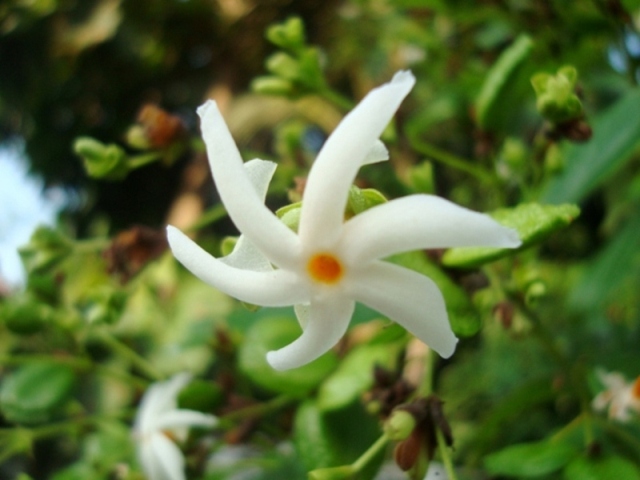
Har shingar is also called Coral Jasmine, Tree of Sorrow, Queen of the night and Night-flowering Jasmine. It is called Har shingar, Shefali, Paarijat  in Hindi, Shefali  and  Shiuli in Bengali, Singarei in Manipuri , Hkhewaliin Assamese , Pagadamalle in Telugu , Pavizhamalli or pavala malli in Tamil, Goli in Kannada , Paarijatam in Malayalam. In Sanskrit it is called Parijata, Prajakta, Vijaya, Subaha, Nalakumkumaka, , Suklangi, Chakrabrinta, Kharapatraka,  Rajanihasa, Nisahasa, Praharshini, Pravalanalika, Vathari, Bhoothakeshi, Seetamanjari, Ragapushpi Nishipushpika. In Oriya we call it Ganga shiuli, Shingda hara, Shefali or Jhara Shefali.
 
Coral Jasmine, Tree of Sorrow, Queen of the night,Night-flowering Jasmine,Har shingar, Shefali, Paarijat,Shiuli,Singarei,Hkhewali,Pagadamalle,Pavizhamalli,Goli,Paarijatam,Prajakta,Ganga shiuli,
Night-flowering Jasmine 

Its botanical name is Nyctanthes arbortristis and it belongs to the Oleaceae i.e. Jasmine family. Nyctanthes arbortristis literally means, night-blooming sad tree. The tree is also called the "tree of sorrow", because the flowers drop from their branches in the morning.

 
It’s generally native to southern Asia and it is a common flower in countries of India, Pakistan, Nepal, Bangladesh and Thailand.  
 
Pavizhamalli,Goli,Paarijatam flower
 Shefali, Paarijat, 
 

It grows as a shrub or a small tree up to 10 m. tall, with a gray or greenish, rough and flaky bark.  Leaves are simple, opposite, oval with pointed tips, 6–12 cm long and 2–6.5 cm broad, toothed at the edges and rough like sandpaper on the upper surface. The flowers are very sweet scented with waxy white, star-like petals and an orange-red tube in center which bloom in clusters. The flowers open at dusk and drop at dawn. The fruit is flat brown heart-shaped, 2 cm diameter and two seeded.
 
The flowers are used as yellow dye for clothing and the oil extracted from the flower is made perfume. 
 
Coral Jasmine, Tree of Sorrow, Queen of the night,Night-flowering Jasmine,
har singar tree.

Every part of the tree is very useful and contains great ayurvedic/medicinal property. It is expectorant, bitter, tonic, febrifuge and is used to treat anxiety, restlessness, headache, gastritis, hepatitis, diarrhea, vertigo and dysmenorrhoea. It is used in the treatment of fungal skin infection, dry cough, and bronchitis and as an antidote for snakebites.  The flowers are bitter, astringent, ophthalmic, stomachic, carminative, diuretic, anti-bilious, antioxidant, anti-inflammatory, sedative, antifilarial and it cures arthritis. The decoction of flowers is used in treating gout. The leaves are used as a laxative. Paste of the leaves is used in skin related troubles, especially ringworm. The leaves are boiled in mustard oil and it is used externally for treating ringworm. The leaf juice is mixed with common salt or misri to treat intestinal worms. For gynecological problems 3 fresh leaves blended with 5 black peppers is taken. If 3-4 leaves are crushed to a fine paste and are boiled with water (the decoction or quatha called in Ayurveda); the water extract taken twice daily cures sciatica, swelling and pain. Juice of leaves taken with honey cures dry cough. Take a handful of leaves with 2-3 leaves of tulsi and boil in water and take two tbsp thrice daily to cure any kind of fever. The seeds are antibacterial and antifungal. The seed paste is externally applied on the piles. The decoction of its seeds is used as a hair tonic. Washing hair daily with this tonic helps to get rid of dandruff and lice.  The bark is anti-microbial. The stem isantipyretic and antioxidant. 200 ml. decoction made from the leaves, barks, flower (when boiled with water and reduces to ¼ of initial quantity) cures arthritis.
Coral Jasmine, Tree of Sorrow, Queen of the night,Night-flowering Jasmine,Har shingar, Shefali, Paarijat,Shiuli,Singarei,Hkhewali,Pagadamalle,Pavizhamalli,Goli,Paarijatam,Prajakta,Ganga shiuli,
 Nyctanthes arbortristis
 
 
I’ll relate one of my personal experiences of the efficacy of the wonderful property of this plant. Around ten years ago during my stay at Cuttack once I suffered from viral fever. The fever subsided after one week. But intermittent slow temperature and feverish feeling continued. I kept taking medicine. After one month I grew tired of them. I asked our housemaid to collect me some leaves of Har shingar tree. She gave it to me. I washed them and boiled them with 1 glass water. When the water was reduced to 1 cup I took it out and let it cool down. Then I crushed the boiled leaves a bit and extracted the water. I took it simply even without honey or Tulsi thrice daily for two or three days. My fever, temperature everything was completely cured without any further medication. I have tried and have got the good result. It has no side effect at all. It’s the miracle medicine for all kinds of fever no doubt. 

N.B.👉All the above is solely for informational purpose and NOT INTENDED TO PROVIDE ANY KIND OF MEDICAL ADVICE. A REGD. AYURVEDIC/MEDICAL PRACTITIONER SHOULD ALWAYS BE CONSULTED FOR IT.

Agasti

Agati sesbania is also known as August flower, Australian corkwood tree, Flamingo bill, Hummingbird tree, Vegetable hummingbird, Grandiflora, Sesban, Swamp pea, Tiger tongue, West Indian pea and white dragon tree. It is called Agasti, Bak, Basma, Basna, Chogache, Hatiya, Gaach Munga in Hindi, Agati, Agusta, Bagphal, Bak, Bake in Bengali, Heta in Marathi, Houwaimal in Manipuri, Agathio in Gujarati, Sevvagatti, Muni, Akatthi and peragathi in Tamil, Agase and agastya in Kannada, Akaththi in Malayalam, Ettagise, Sukanasamu, Avisi and agise in Telugu, Agst in Urdu, Varnari, Munipriya, Agasthi, Agastya, Munitaru, Vangasenaka ,Drigapalaka in Sanskrit. In Oriya we call it Agasti.


Its botanical name is Sesbania grandiflora. The generic name is derived from an Arab word for one of the species, S. sesban. The specific epithet means large-flowered in Latin.
 
 
Agasti or August flower is a small, fast-growing, sparsely branched, soft wooded tree that grows up to 9 meters in height. The plant is short living and quick growing in nature.  The leaves are regular, pinnately compound and rounded, 20 to 30 centimeters long, with 20 to 40 pairs of leaflets which are 2.5 to 3.5 centimeters long. Flowers are long with beautiful, fleshy, white,yellowish, rose pink or red petals up to 10 cm in diameter. The fruits look like flat, long and thin green beans. Pods are linear, flat or 4 cornered, 20-60 centimeters long, 7 to 8 millimeters wide, pendulous and somewhat curved, containing many seeds. It has an outstanding ability to tolerate waterlogging and is ideally suited to seasonally flooded environments. When flooded, it initiates floating, adventitious roots, and protects their stems. S. grandiflora is easily propagated by direct seeding.  It can be grown from cuttings for cultivation.
 
It has great medicinal value as mentioned in ayurveda. All parts of Sesbania grandiflora are utilized for medicine in Southeastern Asia and India including preparations derived from the roots, bark, gum, leaves, flowers, and fruit.

The plant is astringent, febrifuge, vermifuge, antidote, aperient, diuretic, emetic, cardio protective, anti-inflammatory, anti-cancer, anti-ulcer, laxative and tonic. Its Bark is very astringent, Flowers are emollient and laxative, and leaves are aperient, diuretic, laxative. The leaf juice is antioxidant. It has properties which cures rheumatism, liver disorders, fever, arthritis, scabies and night blindness. It is one of the richest natural sources of vitamin A. It has several other medicinal uses, e.g. for treating catarrh, headache and epilepsy. An ingredient which is Cancer inhibitor is found in its seed; it shows antitumor activity. Juice of the root, mixed with honey is used as an expectorant. Juice is extracted from the roots, mixed with honey is used as an expectorant for colds and catarrh. The solution formed by boiling the bark in water is given as a remedy for fever, diarrhea, dysentery and small pox. A paste is made from the roots of the red flowered Sesbania grandiflora and is given as remedy for rheumatism. Decoction of the bark used for hemoptysis. Infusion of the bark is given to treat smallpox and other eruptive fevers, diarrhea and dysentery. Juice of flowers is taken as snuff to clear the sinuses. The Poultice of its leaves is applied to heal bruises. Decoction of bark used as vomitive. The fruits are used to treat anemia, bronchitis, fever, turmors; flowers for gout, bronchits, nyctalopia. The leaf juice can remove the intestinal worm. A tea made from the leaves is believed to have antibiotic, anthelmintic, antitumour and contraceptive properties. The bark is considered as a tonic and an antipyretic, a remedy for gastric troubles, colic with diarrhoea and dysentery. A bark decoction is taken orally to treat fever and diabetes. Juice of flowers put in the eyes is said to relieve dimness of vision. The leaves also have medicinal value and are reported to cure night blindness in cattle. In India, all plant parts are reputed to cure night blindness. The root is a well-known medicine for malaria. The principal medicinal effects are due to the tree’s astringency; hence it is used against inflammation, venom and other poisons, bacterial infections and tumors. g. For systemic disorders, decoctions are taken internally. Root resin, mixed with honey, is taken orally for phlegm. For women’s health issues such as white discharge or vaginal discharge accompanied with odour, these leaves are proven to be a great cure option. The bark decoction is used for treating diabetes. Sesbania Grandiflora' flowers have a special ability to improve vision. The juice of the flower is squeezed into eyes to eliminate dullness in vision. The leaves also have medical benefits to treat night blindness. Similarly, the roots are used as medical component in curing malaria. Juice or extract made out of the roots are applied itching and swelling problems. When this is consumed internally, system disorders are cured. For phlegm or cough the root resin mixed with honey and one teaspoonful of this mixture is taken.
One important caution to be remembered is that this plant should not be used during the course of any other medication without consulting an ayurvedic doctor because the current medicine might render it almost ineffective. All the medicinal value and usage of these herbs are for informational purpose only. No treatment should be made for any illness without consulting a regd. Medical/ayurvedic doctor.

The flowers, young leaves and tender pods of the white flowered Agasti are edible. Young pods are eaten like string beans. Flowers are an excellent source of calcium, fair source of iron and very good source of vitamin B. It typically produces a soft wood, however, the density of the wood increases with age and the timber from 5-8 year old trees is used in house construction or as craft wood. The wood is of low quality. The tree has potential uses as pulp fibre, firewood, animal fodder or green manure and landscape decoration. It also has potential for reforesting eroded land and grassy wastelands. It’s excellent forage for growing goats.

Here in my state i.e. Orissa during the pious month of Kartik (which is November), the old women especially widows observe their habisha or fasting and worship Lord Vishnu in the form of Lord Jagannath. During Habisha they observe great penance, they don’t use oil, don’t take any non-veg food, or garlic, onion or spicy curry. They eat sunned (arua) rice, moong or masoor dal. Only limited and particular vegetables are allowed to take, like plantain, yam, and arum. The dalma or dal with these vegetables is cooked without oil or spice. Only a little bit of ghee is allowed. During this period of penance and austerity they cook and eat the leaves of Agasti as a leafy vegetable or saag. Most probably because of its good iron content it has been introduced traditionally as a good nutrition supplement.


All parts of this unique plant are useful. It’s an extremely useful tree. But I know no tree which is not useful :).


Country-mallow

Country-mallow is also known as Snake mallow, flannelweed, Heartleaf Fanpetals, Long-stalk Sida, Heart-Leaf Sida etc. it is called Bananiyar, Faridbuti, Bhyunli and bhuinii in Hindi , Bhumi petari, Bhuinchikna, Bhoybal in Marathi, Junka in Bengali, Kurunthotti, Palampasi, Mayirmanikkam in Tamil, Vallikkuruntotti, Kuruntotti, Nela-Vaga in Malayalam, Benda, Gayapaku, Tirunala in Telugu, Bekkinathale Gida in Kannada, Bhoybala in Gujarati , Bhumibala, Nagabala, Rajbala, Gangeruki, Visvadeva, Jhasna, Kharagandhika, Khanda, Hrasva Gavedhuka in Sanskrit. In Oriya we call it Bisiripi.
 

Its Botanical name is Sida Cordata (also Melochia cordata, Sida humilis, Sida veronicifolia). The generic name Sida Cordta is derived from Greek word Sida which means a species of water lily. Cordata means heart shaped. The leaves of the plant have obviously that shape.


It’s a common weed found everywhere in tropical countries. It is found throughout India in roadsides and wastelands.


It’s a non-woody hairy herb with slender trailing branches, sparingly hispid, frequently procumbent and sometimes rooting at nodes. The stem, petioles & pedicles of the plant are hairy. The leaves are long petioled, ovate to cordate, acuminate, and serrate with alternate and short teeth. The flowers are pale yellow, usually solitary or borne in pairs or in small cymes, found in axils. Fruits are schizocarp located within the persistent calyx. The Seeds are brownish and sub-globose and 3.5 to 3.8 mm. in diameter. It is a perennial plant. It flowers and fruits throughout the year.
  
The whole plant has great medicinal value. The roots taste sweet, sour, bitter and acrid. It is astringent, stomachic, febrifuge, thermogenic and tonic. It’s a good medicine for treatment in uropathy. So it is diuretic. The juice of the whole plant is used in retention of urine, urinary infection, dysuria, and spermatorrhoea. The bark of the root is used for treatment of leucorrhoea, gonorrhea and hyperdiuresis. It has haemostatic, analgesic and wound healing properties. The leaf paste is applied as a poultice to cuts and bruises. Paste of either root or leaves is used in bleeding disorders and wounds. It is applied in elephantiasis also. The flowers and unripe fruits are refrigerant, it is mixed with sugar and is given to relieve burning sensation. This mixture is also used to treat micnutrition. The leaves are known as demulcent and are used in opthalmia. Seeds are considered as laxative and are recommended in crysittiscolic tenseness and piles. The plant is useful in acidity, peptic disorder, constipation, relieves flatulence and heartburn.The whole plant is used in treatment of skin troubles, rheumatism, asthma, cough, bronchitis, and diarrhoea. The decoction of the entire plant is given to prevent joint swellings in arthritis. Being a nervine and brain tonic, it is useful in treatment of loss of memory, general debility and muscle wasting. It is also used to convalesce from post- abortion weakness. It acts as an aphrodisiac and used in loss of libido. It has nourishing and rejuvenating properties. It used in neuromuscular disorders with loss of function and weakness. It is especially used in chronic respiratory disorders where it helps eliminating accumulated mucus, promotes healing and restores the strength. It cures dyspnoea, tuberculosis and hoarseness of voice.
  
 
How wonderful it is! Just think. It seems such a small and seemingly insignificant weed with tiny flowers which grows in wasteland. But see how potent it is with such great medicinal value. That’s called the magic of nature and handiwork of the lord.


(+)